Showing posts with label Modern Serbian Architecture. Show all posts
Tuesday, November 29, 2011
6 Cool Buildings in Banja Luka
Banja Luka the administrative capital of the Republika Srpska, is a beautiful town with lots of interesting buildings from the last century like the Banski Dvor (Бански Двор) (1932), the National Theater (Народно позориште Републике Српске) (1933), The City Hall (Градска палата) (1934), The Palace of the Republic (Палата Републике Српске) (1936) and the buildings on the Promenade - Gospodska street (officially Veselin Masleša street).
(Picture from Panoramio)
What interests me more about Banja Luka are a few modern buildings that I want to show here in this post:
1. Dom Vojske
Today it is the National Assembly of the Republika Srpska (Народна скупштина Републике Српске. (picture from panoramio and skyscrapercity)
2. The Retirement Home (Старачки Дом)
The building looks quiet interesting, it was started in 1989 and it's still not finished.
(picture from Teča sa Dunava)
3. The Borik Sport Center (Спортска дворана Борик)
This Sport Center is a typical 1970's structured concrete building and lays in the Borik neighboorhood. (picture from wikipedia).
Borik is a neighborhood of Banja Luka. It was built northeast of the old city center after an earthquake in 1969 when Banja Luka was heavily damaged. Borik was planned for housing of people who lost their homes in an earthquake and it was built in a modern socialist architectural style, typical for cities that were developed under an influence of a communist system. (picture from scborik).
The building is from 1974, can seat about 5'000 people and is used for different Sports and for Concerts.
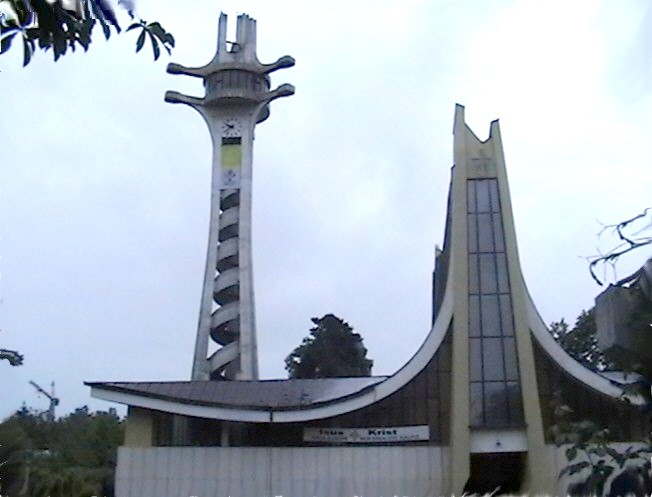
4. The Cathedral of Saint Bonaventure
The Cathedral of Saint Bonaventure is one of four Roman Catholic cathedrals in Bosnia and Herzegovina. The Cathedral was built in honor of Saint Bonaventure, a Franciscan theologian from the Middle Ages. It was constructed by Alfred Pichler in the 1970s after the original had been damaged in the 1969 earthquake.
It was built in a tent like shape. The bell tower was added in 1990.(picture)
5. Boska Shopping Center
“Boska” department store (from 1978) is a building that looks like from outer space. Its shape was designed without any direct formal relationship to the local heritage.
picture by http://www.bojanfajfric.net
It's kind of a landmark of Banja Luka, due to its location (in the very center on a big pedestrian square) and to its over-sized shape. It stands there as a nostalgic symbol of former Yugoslavia and never underwent any changements. (picture from panoramio)
6. Hotel Turist in Celinac (near Banja Luka)
The last of the 6 buildings is not really in Banja Luka. But with its prefab facade, its round-corner-windows and daring color concept fits into this list of cool buildings.
The hotel has 35 beds and a restaurant. (Pictures from panoramio)
And here a few links for visiting Banja Luka:
• Banja Luka Online Guide
• The Banja Luka in your pocket guide to download
(it's from 2009) but still useful
Here you can download a map of the City of Banja Luka
Sunday, October 9, 2011
Dr. Djuric Apartment Block by Branislav Kojic
This Building at the corner of Prizrenska Street in Belgrade made by Branislav Kojic in 1933 is regarded as one of the most successful example of modernism in Belgrade.
(two pictures above from rascian at skyscrapercity)
After the collapse of the Habsburg monarchy and the establishment of the Kingdom of Serbs, Croats and Slovenes (known as Yugoslavia from 1929), Belgrade grew into its new role as a modern capital city.
Thanks to the "group of architects of modern direction" founded in 1928 by Branislav Kojic, Milan Zlokovic, Jan Dubovy and Dusan Babic, Belgrade had its own "Modernism" and some great examples are still preserved around the city.
I already posted about some of those buildings here:
• Hotel Posta by Bransilav Kojic
http://sajkaca.blogspot.com/2011/02/hotel-posta-in-belgrade.html
• Observatory by Jan Dubovy
http://sajkaca.blogspot.com/2010/05/zvezdara-observatory-first-modernism.html
• Villas by Dusan Babic
http://sajkaca.blogspot.com/2009/05/modern-buildings-in-belgrade-by.html
http://sajkaca.blogspot.com/2010/05/3-villas-of-dusan-babic-today.html
• And the Chldren's Hospital by Milan Zlokovic
http://sajkaca.blogspot.com/2010/02/belgrade-university-clinic-for-children.html
model of the project (http://www.muzejnt.rs)
The difference between modernism in western Europe and Belgrade, was the rift between the architect intensions and the building industry. The Serbian Modernists had often to renounce to some details due to the lacking of commercial demand and had poor support from the building industry.
The industry rather used "modern" style to economize on stucco and ornaments (style elements of the architecture until Modernism) to increase the profit margins.
(picture from elusive margine of belgrade architecture by Ljiljana Blagojevic)
The common organization of commercial use in the ground floor and mezzanine and apartments in the upper floors is here combined with a clever use of its location at a corner site. The apartments have terasses toward west looking down to the Sava river.
(picture from goldi at skyscrapercity)
Kojic used a modern language to enhance a horizontally layered podium with stores and mezzanine, a vertical corpus as athe main body with apartments and concluding with concrete sheltering roof terrasses.
He used the terrasses also to accentuate the exposed corners of the building and gave the building a shape following the side street.
(picture from goldi at skyscrapercity)
(picture from elusive margine of belgrade architecture by Ljiljana Blagojevic)
For more on Belgrade's Modernism:
Monday, July 4, 2011
Interesting Buildings in Majdanpek
You would not suspect that Majdanpek (Мајданпек) is a secret architectural treat! It is a little town with 10'000 inhabitants in Eastern Serbia and is actually in one of the poorest regions of Serbia. But just economically speaking. The town was famous as a copper mine district, since the early 17th century. The origin of the name is based on the words majdan (fromTurkish madän, mine) and river Pek (mine on river Pek). Throughout its history, mining development was held by many foreign owners (Czechs, Belgians, Austrians), and was extensively exploited.
A postcard from 1975
The town was industrialized in the mid-20th century, by the industrial program supported by SFR Yugoslavia's Government of that time, and was under the personal influence of Tito; and this you can literally see on the urban layout and the main constructions.
Through the late 20th century, the town was in a period of industrial progress and one of the most developed areas in copper mining and metallurgy of former Yugoslavia.
Being in the SFRJ industrial program produced a row of interesting buildings, in socialist mood and rather unexpected shapes and layouts.
Here some cool highrise buildings. Similar like the blocks in Novi Beograd, the goal was to produce a lot of apartments in a very short time to accommodate all the miners.
The fall of industrial production was a consequence of war and NATO sanctions during the 1990s. Now, Majdanpek is struggling to renew industrial production.
The former Hotel Kasina (now Golden Inn) but actually closed.
Stylish Interiors of the Golden Inn; Kasina Hotel, Majdanpek, 2001, C-print by Vesna Pavlovic (on flickr)
A postcard from 1975
The town was industrialized in the mid-20th century, by the industrial program supported by SFR Yugoslavia's Government of that time, and was under the personal influence of Tito; and this you can literally see on the urban layout and the main constructions.
the administration building
Through the late 20th century, the town was in a period of industrial progress and one of the most developed areas in copper mining and metallurgy of former Yugoslavia.
Older postcard (60's) from the same building
Being in the SFRJ industrial program produced a row of interesting buildings, in socialist mood and rather unexpected shapes and layouts.
Here some cool highrise buildings. Similar like the blocks in Novi Beograd, the goal was to produce a lot of apartments in a very short time to accommodate all the miners.
The fall of industrial production was a consequence of war and NATO sanctions during the 1990s. Now, Majdanpek is struggling to renew industrial production.
The former Hotel Kasina (now Golden Inn) but actually closed.
Stylish Interiors of the Golden Inn; Kasina Hotel, Majdanpek, 2001, C-print by Vesna Pavlovic (on flickr)
More stylish interiors (from the Hotel's website)
Another angle of the Hotel and the city center
the city park
The combination of apartment modern buildings and a old style church (the church was built in non-orthodox Style (a Swiss Style was imitated) to satisfy the foreign workers. For the same reason it was conceived as serbian-orthodox AND! a catholic church.
The Youth Club Majdanpek: a UFO-like building
In the wild mountainous beauty of Eastern Serbia, Majdanpek with its clear layout stands out.
An overview of the carefully planned city center and below
An orientation plan for Majdanpek with all the interesting buildings
(pictures if not otherwise mentioned are from Skyscrapercity)
Sunday, June 26, 2011
Interesting buildings in Arandjelovac
After checking out interesting buildings in Kragujevac (here) I collected here a few interesting buildings in Arandjelovac (Аранђеловац) in Central Serbia which like Kragujevac also lies in the Sumadija region and has about 50'000 inhabitants.
Architecture is not the reason why this city is visited by tourists, however I found a couple of interesting buildings I'd like to share here.
Arandjelovac is mostly known for the spring of the popular mineral water "Knjaz Milos" and the appertaining Spa "Bukovicka Banja". The Spa has a great park loaded with sculptures international artists (since 1966 the city invites artist from all over the world and let them have one of their sculptures exposited in the Park.
Inside the Spa facilities there is an example of Serbian Romaticism it's the "Staro Zdanje" (the Old Building) and is the oldest preserved building in Bukovicka Banja Spa. It was initiated by Prince Mihailo Obrenovic (that's why the mineral water is called "Knjaz Milos") in 1865 and was intended as his summer residence and for Assembly meetings.
Here an old picture of the building.
Its architect, Kosta Sreplovic, the Munich school of architecture graduate, landscaped the park area in front of the edifice as well. When the edifice was completed in 1872, the purpose of its use was changed due to altered political situation so that it became a spa edifice, probably the largest of the kind in Serbia of the time.
Today it is a hotel and the symbol of Arandjelovac that appears in its coat of arms, prospectus leaflets and postcards.
This highrise building is known as the "arandjelovac soliter" and is in the center of the city.I love the rounded details and the material combinations.(picture source)
Blocks like this remind a lot the Style of Novi Beograd.
A really cool building and and a sign of past socialist times is the shopingcenter "Kolektiv" (Робна кућа Колектив) with its sculptural facade.(picture source)
Here an old Postcard with the Kolektiv-Building and the Arandjelovac-Soliter in the background.
Another interesting building is the the one with the "Pekabeta" on the ground-floor. The peculiar blue attic adds a fun touch to the edifice and makes it unique.(picture source)
The building of the Municipal Court has also a socialist time touch.
And now a really beautiful example of Brutalism: the Bukulja observatory tower on the Bukulja Mountain near Arandjelovac on 660 m. above sealevel and 19m high, made in nice face concrete. From the top there is a nice view to the surrounding mountains. Now it's planned to put a telescope up there to make it a even better tourist attraction.
Anrandjelovac is worth a trip also for the cultural meaningful surrounding: The Bukovicka Spa, Topola with the Oplenac Royal Mausoleum and the Risovaca Caves.
Architecture is not the reason why this city is visited by tourists, however I found a couple of interesting buildings I'd like to share here.
Arandjelovac is mostly known for the spring of the popular mineral water "Knjaz Milos" and the appertaining Spa "Bukovicka Banja". The Spa has a great park loaded with sculptures international artists (since 1966 the city invites artist from all over the world and let them have one of their sculptures exposited in the Park.
Inside the Spa facilities there is an example of Serbian Romaticism it's the "Staro Zdanje" (the Old Building) and is the oldest preserved building in Bukovicka Banja Spa. It was initiated by Prince Mihailo Obrenovic (that's why the mineral water is called "Knjaz Milos") in 1865 and was intended as his summer residence and for Assembly meetings.
Here an old picture of the building.
Its architect, Kosta Sreplovic, the Munich school of architecture graduate, landscaped the park area in front of the edifice as well. When the edifice was completed in 1872, the purpose of its use was changed due to altered political situation so that it became a spa edifice, probably the largest of the kind in Serbia of the time.
Today it is a hotel and the symbol of Arandjelovac that appears in its coat of arms, prospectus leaflets and postcards.
This highrise building is known as the "arandjelovac soliter" and is in the center of the city.I love the rounded details and the material combinations.(picture source)
Blocks like this remind a lot the Style of Novi Beograd.
A really cool building and and a sign of past socialist times is the shopingcenter "Kolektiv" (Робна кућа Колектив) with its sculptural facade.(picture source)
Here an old Postcard with the Kolektiv-Building and the Arandjelovac-Soliter in the background.
Another interesting building is the the one with the "Pekabeta" on the ground-floor. The peculiar blue attic adds a fun touch to the edifice and makes it unique.(picture source)
The building of the Municipal Court has also a socialist time touch.
And now a really beautiful example of Brutalism: the Bukulja observatory tower on the Bukulja Mountain near Arandjelovac on 660 m. above sealevel and 19m high, made in nice face concrete. From the top there is a nice view to the surrounding mountains. Now it's planned to put a telescope up there to make it a even better tourist attraction.
Anrandjelovac is worth a trip also for the cultural meaningful surrounding: The Bukovicka Spa, Topola with the Oplenac Royal Mausoleum and the Risovaca Caves.
Thursday, June 16, 2011
Interesting Buildings in Kragujevac
Now that the traveling season starts and a few of my readers were asking for architectural tips outside from Belgrade, I decided to publish the most interesting buildings of smaller Serbian cities next to useful traveling information.
I started with Kragujevac and I choose the buildings that I like the most. Kragujevac is the center of the Sumadija region, the region that represent Serbia in all its stereotypes (for instance the Sumadija folk costume stands generally as illustration for Serbian national costume).
Blocks in Kragujevac (from flickr)
The architecture of Kragujevac is a mix of various styles: there are Oriental-Style buildings (like the Amidža Konak from 1819-24) and Secession Style buildings from 19th century. Then there are modern post-war concrete buildings (apartments to house those left homeless during World War II), high-rise commies (communist time blocks) and some eye-catching buildings from the 70'ies (like the "Ipsilon" and the City Hall) that now characterize the city's panorama.
Kragujevac City Hall (Скупштина града)from Dinke at flickr
The Y - Building (Ипсилон) in Erdoglija District was built in the 70's and is Kragujevac's tallest building (60m, 17 floors)
Ipsilon Building from woodland at Skyscrapercity
The Golden Rose Shopping Center "Златна Ружа" is a cool building, however it needs some remodeling work. (from Johnny-kg at skyscrapercity)
Fire station in ulica Miloja Pavlovića (Ватрогасци дом) picture from skyscrapercity. Below an old picture of the building.
The fire station is a modernist building from 1932 (built in less than one year!)after the project of Đorđe Kovaljevski i Mihailo Radovanović, two Belgrade architects.
The "Zastava"-Building is a good example of soc-realism. (Picture from kawasaki KG at skyscrapercity)
The history behind the building and what happened to the Zastava Industry is a bit complexer. In a very simple and short form I see it like this: The biggest and flourishing Industry that produced some Yugoslavian legendary cars was wrecked by NATO bombings and later through Embargo and Sanctions. Now Italy (who 11 years ago was bombing the buildings) is trying to produce FIAT cars in these buildings, to make cheaper production with cheap Serbian workers and taking away the works to many Torino based workers in Italy…..but that's business…
Main site of Zastava
An interesting building (I already wrote about this one here) is located a little outside Kragujevac in the Šumarice Memorial Park (Меморијални парк Шумарице), is the Museum of Genocide, on the site where in WW II between 2'300 and 7'000 men and boys (the numbers differs a lot from source to source, but that's another issue…) were executed by the German occupation forces on October 20, 1941.
The project is made by Ivan Antic.
Antic designed the Museum of the Genocide in 1967. The grandness of the monumental building is emphasized by a series of tall pillar-like rectangular shapes, the tallest ones on the central part from which go the same ones of various height with massive parts of the walls built in brick.
The modern expression relates to medieval sacral architecture, and the symbol of the Museum of the Genocide is even stronger in the interior which lets natural light from roof lanterns, connecting the view to the skies with earthly life: the building and the crypt.
On May 14th 1999 due to the detonation of NATO attacks in the nearest vicinity the facades of the Museum were damaged and all glazed panels and roof lanterns destroyed. The nearby building of the Archives was badly damaged. (picture from skyscrapercity)
There is also a famous monument called "Broken Wings"-Monument created in 1963 by Serbian sculptor Miodrag Zivkovic.
The monument is dedicated to the killed schoolchildren and their teachers.
"Broken wings" monument in Sumarice memorial park (picture from Balkanforum)
Here a few links with travel tips for Kragujevac:
http://www.kragujevac.rs
http://wikitravel.org/en/Kragujevac
And here a cool blog from JohnnyKG that has pictures and further Kragujevac links.
Subscribe to:
Posts (Atom)