Tuesday, November 29, 2011

6 Cool Buildings in Banja Luka


Banja Luka  the administrative capital of the Republika Srpska, is a beautiful town with lots of  interesting buildings from the last century like the Banski Dvor (Бански Двор) (1932), the National Theater (Народно позориште Републике Српске) (1933), The City Hall (Градска палата) (1934), The Palace of the Republic (Палата Републике Српске) (1936) and the buildings on the Promenade - Gospodska street (officially Veselin Masleša street).
(Picture from Panoramio)

What interests me more about Banja Luka are a few modern buildings that I want to show here in this post:

 1. Dom Vojske

 Today it is the National Assembly of the Republika Srpska (Народна скупштина Републике Српске. (picture from panoramio and skyscrapercity)


2. The Retirement Home (Старачки Дом)


 The building looks quiet interesting, it was started in 1989 and it's still not finished.
 (picture from Teča sa Dunava)

3. The Borik Sport Center (Спортска дворана Борик)

This Sport Center is a typical 1970's structured concrete building and lays in the Borik neighboorhood. (picture from wikipedia).


Borik is a neighborhood of Banja Luka. It was built northeast of the old city center after an earthquake in 1969 when Banja Luka was heavily damaged. Borik was planned for housing of people who lost their homes in an earthquake and it was built in a modern socialist architectural style, typical for cities that were developed under an influence of a communist system. (picture from scborik).


The building is from 1974, can seat about 5'000 people and is used for different Sports and for Concerts.

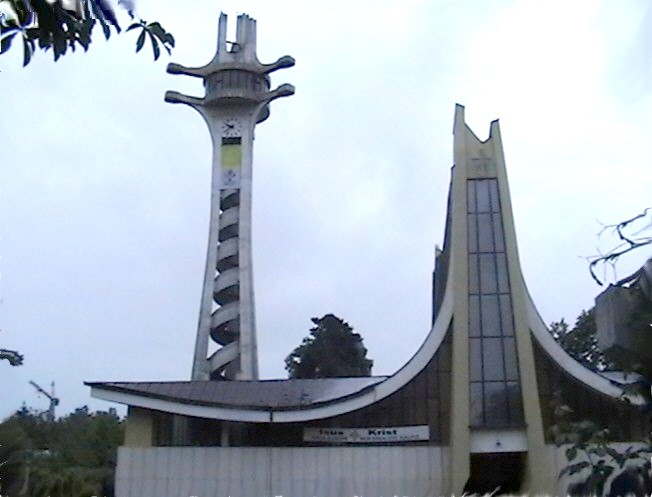
4. The Cathedral of Saint Bonaventure


The Cathedral of Saint Bonaventure is one of four Roman Catholic cathedrals in Bosnia and Herzegovina. The Cathedral was built in honor of Saint Bonaventure, a Franciscan theologian from the Middle Ages. It was constructed by Alfred Pichler in the 1970s after the original had been damaged in the 1969 earthquake.
It was built in a tent like shape. The bell tower was added in 1990.(picture)

5. Boska Shopping Center


“Boska” department store (from 1978) is a building that looks like from outer space. Its shape was designed without any direct formal relationship to the local heritage.

picture by http://www.bojanfajfric.net


It's kind of a landmark of Banja Luka, due to its location (in the very center on a big pedestrian square) and to its over-sized shape. It stands there as a nostalgic symbol of former Yugoslavia and never underwent any changements. (picture from panoramio)

6.  Hotel Turist in Celinac (near Banja Luka)


The last of the 6 buildings is not really in Banja Luka. But with its prefab facade, its round-corner-windows and daring color concept fits into this list of cool buildings.

The hotel has 35 beds and a restaurant. (Pictures from panoramio)


And here a few links for visiting Banja Luka:
Banja Luka Online Guide
• The Banja Luka in your pocket guide to download
  (it's from 2009) but still useful

Here you can download a map of the City of Banja Luka


Sunday, November 20, 2011

University of Sydney

The University of Sydney is a public university located in Sydney, New South Wales. The main campus spreads across the suburbs of Camperdown and Darlington on the southwestern outskirts of the Sydney CBD. Founded in 1850, it is the oldest university in Australia and Oceania. It has 32,393 undergraduate and 16,627 graduate students (2011).[3]

The University of Sydney is organised into sixteen faculties and schools, through which it offers bachelor's degrees, master's degrees, and doctoral degrees. Three Nobel laureates have been affiliated with the University as graduate and faculty.

Sydney consistently ranks amongst the top universities in Australia and Oceania. In 2011, it was ranked 38th in the world; 3rd in Australia, behind Australian National University (26th) and the University of Melbourne (31st) in the 2011 QS World University Rankings.[4]

The University of Sydney is a member of Australia's Group of Eight, Academic Consortium 21, the Association of Pacific Rim Universities (APRU) and the Worldwide Universities Network. The University is also colloquially known as one of Australia's sandstone universities.
In 1848, in the New South Wales Legislative Council, William Wentworth proposed a plan to expand the existing Sydney College into a larger university. Wentworth argued that a state university was imperative for the growth of a society aspiring towards self-government, and that it would provide the opportunity for 'the child of every class, to become great and useful in the destinies of his country'. It would take two attempts on Wentworth's behalf, however, before the plan was finally adopted.

The University was established via the passage of the University of Sydney Act,[5] which was signed on 1 October 1850. Two years later, the University was inaugurated on 11 October 1852 in the Big Schoolroom of what is now Sydney Grammar School. The first principal was John Woolley. On 27 February 1858 the University received its Royal Charter from Queen Victoria, giving degrees conferred by the university rank and recognition equal to those given by universities in the UK.[6] By 1859, the University had moved to its current site in the Sydney suburb of Camperdown.

In 1858, the passage of the Electoral Act provided for the University to become a constituency for the New South Wales Legislative Assembly as soon as there were 100 graduates with higher degrees. This seat in Parliament was first filled in 1876, but was abolished in 1880 one year after its second Member, Edmund Barton, was elected to the Legislative Assembly.

Most of the estate of John Henry Challis was bequeathed to the University, which received a sum of £200,000 in 1889. This was thanks in part due to William Montagu Manning (Chancellor 1878–1895) who argued against the claims by British Tax Commissioners. The following year seven professorships were created; anatomy, zoology, engineering, history, law, logic & mental philosophy, and modern literature.
The New England University College was founded as part of the University of Sydney in 1938, and separated to become the University of New England in 1954.
The University of Sydney in the early 1870s, as viewed from Parramatta Road.

During the late 1960s, the University of Sydney was at the centre of rows to introduce courses on Marxism and feminism at the major Australian universities. At one stage, newspaper reporters descended on the University to cover brawls, demonstrations, secret memos and a walk-out by Professor David Armstrong, a respected philosopher who held the Challis Chair of Philosophy from 1959 to 1991, after students at one of his lectures openly demanded a course on feminism.[7] The philosophy department split over the issue to become the Traditional and Modern Philosophy Department, headed by Armstrong and following a more traditional approach to philosophy, and the General Philosophy Department, which follows the French continental approach.

Under the terms of the Higher Education (Amalgamation) Act 1989 (NSW)[8] the following bodies were incorporated into the University in 1990:

* the Sydney Branch of the Sydney Conservatorium of Music
* the Cumberland College of Health Sciences
* the Sydney College of the Arts of the Institute of the Arts
* the Sydney Institute of Education of the Sydney College of Advanced Education
* the Institute of Nursing Studies of the Sydney College of Advanced Education
* the Guild Centre of the Sydney College of Advanced Education.

Prior to 2011, the Sydney Institute of Education was the Sydney Teachers College.
The Main Quadrangle from University Place

The Orange Agricultural College (OAC) was originally transferred to the University of New England under the Act, but then transferred to the University of Sydney in 1994, as part of the reforms to the University of New England undertaken by the University of New England Act 1993[9] and the Southern Cross University Act 1993.[10] In January 2005, the University of Sydney transferred the OAC to Charles Sturt University.